
Chart-maxxing
I'm starting to write less, but chart more


I made a promise to write one essay a week, but have fallen short over the last month. However, I haven’t been inactive! I’ve shifted my focus to chart-maxxing, posting daily charts on X and Substack Notes. If you’re unfamiliar with the term, “-maxxing,” then that’s likely a good thing… I’ll just leave it at that.
Most of my readers don’t follow my tweets or notes, so I’m going to use this post as a way to consolidate my recent charts. I’m going to supplement the charts with a bit of commentary. These are the thoughts I’ve thought about over the course of the last few days; hopefully, you find them somewhat helpful.
I. TikTok grows 13% globally; X is quietly coming back.
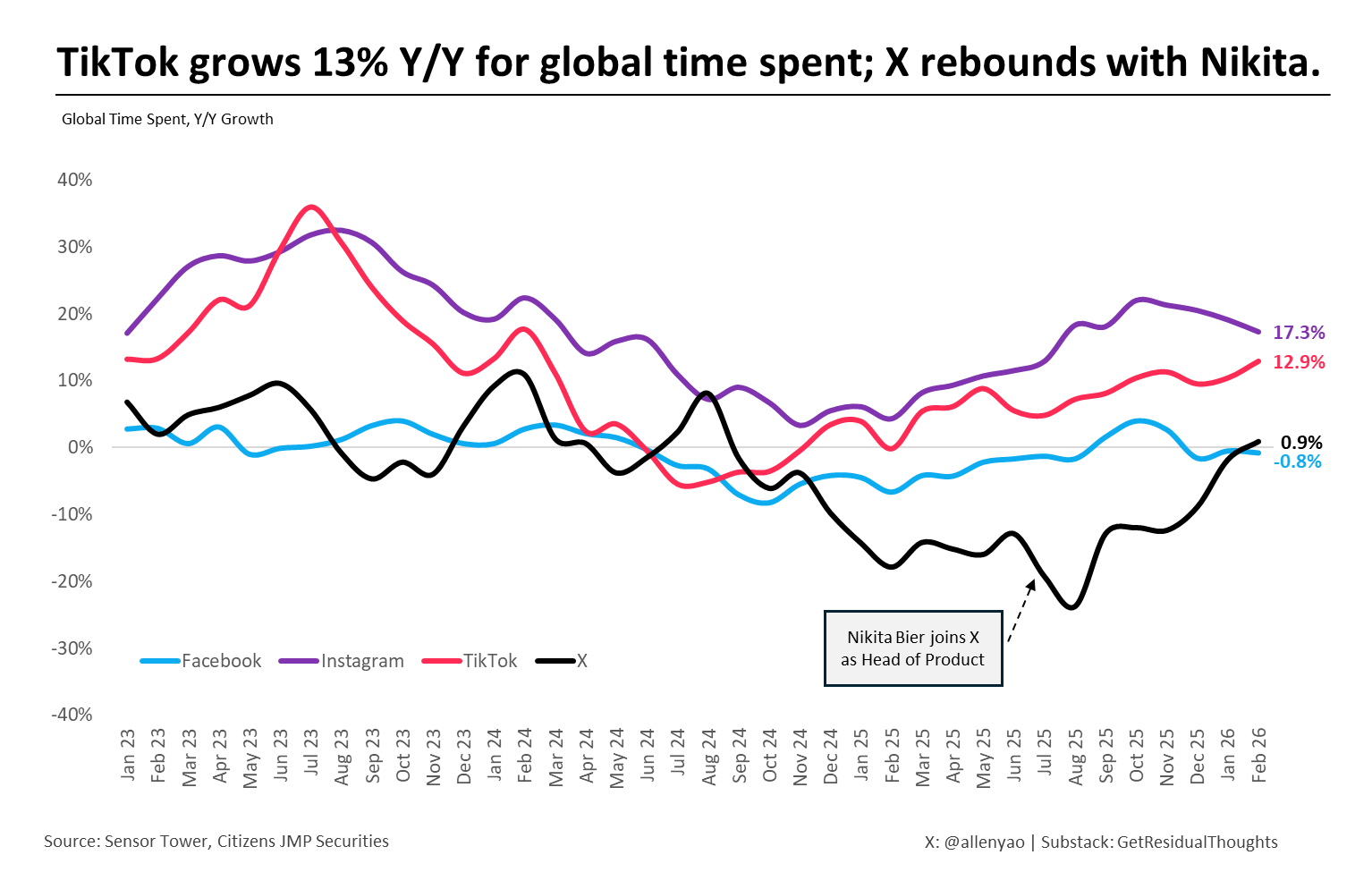
The attention economy is one to watch given the AI tailwind to online shopping, ecommerce, and personalized ad delivery. TikTok’s 13% Y/Y growth in global time spent confirms what advertisers already know: the app’s grip on eyeballs hasn’t loosened despite years of regulatory headwinds and “TikTok is dying” narratives. Instagram’s 17% growth is arguably the more interesting story though: Meta has successfully turned the existential threat of short-form video into fuel for its own engine, with Reels doing the heavy lifting on engagement recovery.
The X chart is the one worth watching. The platform cratered to nearly -25% Y/Y time spent at its trough, a level that would signal terminal decline for most consumer apps. But the inflection following Nikita Bier’s arrival as Head of Product is hard to dismiss. X going from -25% to nearly flat in under a year is a turnaround that deserves more credit than it’s getting.
Importantly, my main interest lies in the shape of the graph. Facebook has found maturity, while TikTok and X seem to be trending upwards.
II. Market punishes Capex spend… maybe too much.
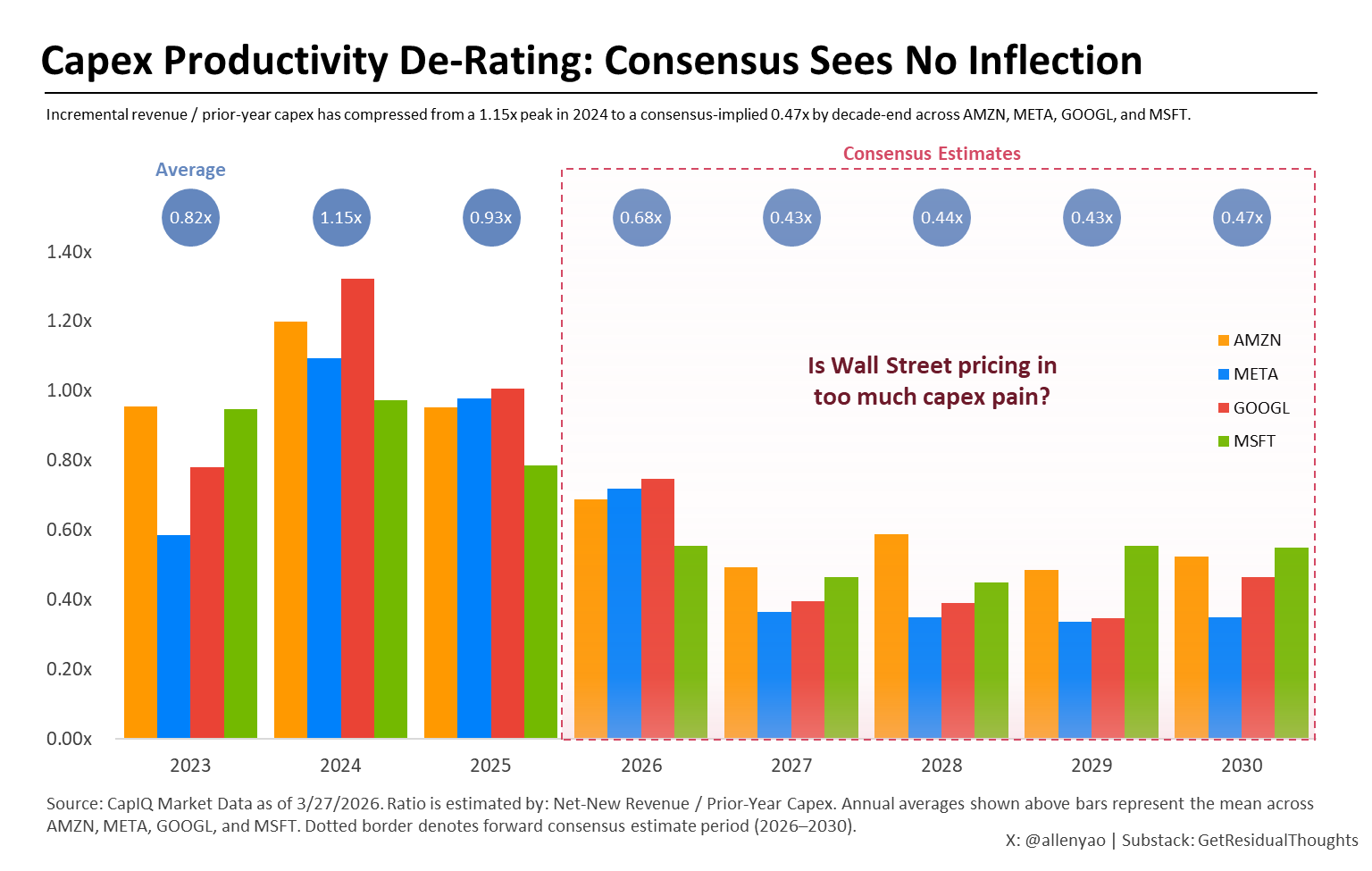
Is Wall Street too punitive on the hyperscalers?
In 2025, the hyperscalers generated $0.93 in incremental revenue for every dollar of capex spent the prior year. Consensus has this falling to $0.68 in 2026 and $0.47 by 2030.
That’s a significant de-rating baked into estimates for the next five years.
Out of the four, the street believes META 0.00%↑ is the most capital inefficient. It’s a logical assumption to underwrite. Unlike AMZN 0.00%↑ , GOOGL 0.00%↑, and MSFT 0.00%↑ , Meta doesn’t sell compute directly. The demand for the other three as CSPs is clear: they are the door to obtaining more compute. Meta’s ROI on Llama, Reality Labs, and its AI assistant buildout is murkier and longer-dated.
But I still think we’re being too punitive on Meta.
The key need-to-believe is the AI + ads reacceleration story. Engagement is up, Advantage+ is working, and monetization per user has room to run. The additional upside from their Personal Superintelligence buildout is harder to underwrite, but hard to dismiss when you have 3.5bn users to distribute through.
Of course, it all depends on execution. But consensus is pricing in near-permanent inefficiency. I wouldn’t be surprised to see an inflection in 2026 and beyond. The street has passed judgment early.
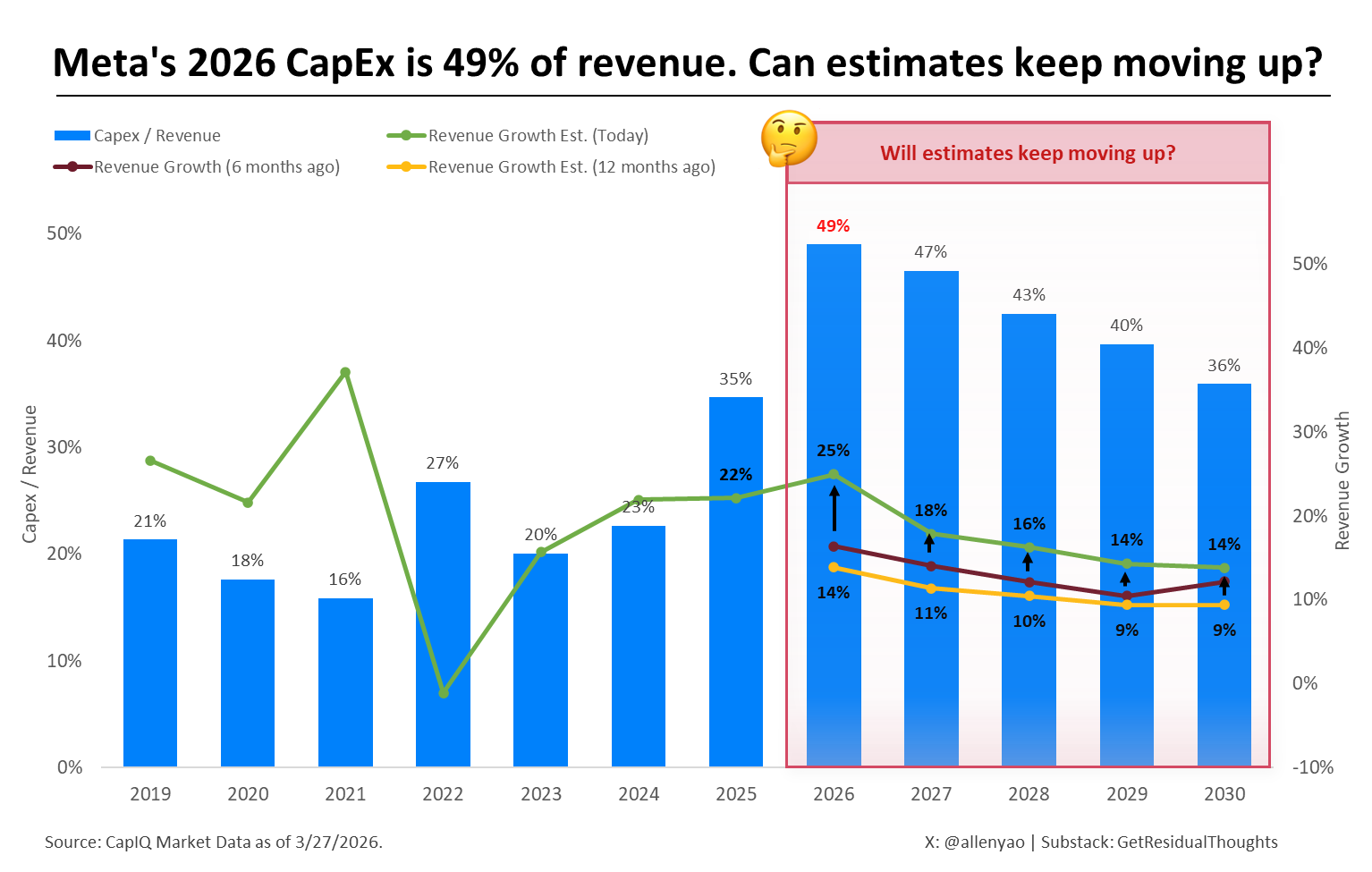
Just a year ago, analysts thought META 0.00%↑ would grow 14% in 2026. The street has now revised estimates to 25% YoY growth. But that’s still only 3ppt higher than 2025’s growth. At 49% capital intensity, does revenue growth have more room to run up?
However, what this tells us is that sell-side analysts hate modeling in re-acceleration stories. The logical way to model is growth deceleration. To make the incremental revenue / capex spend make sense, one would need to model in reacceleration in the top-line, which is hard to do. This explains the compression of capex productivity.
III. If history is correct, we should buy the fear.
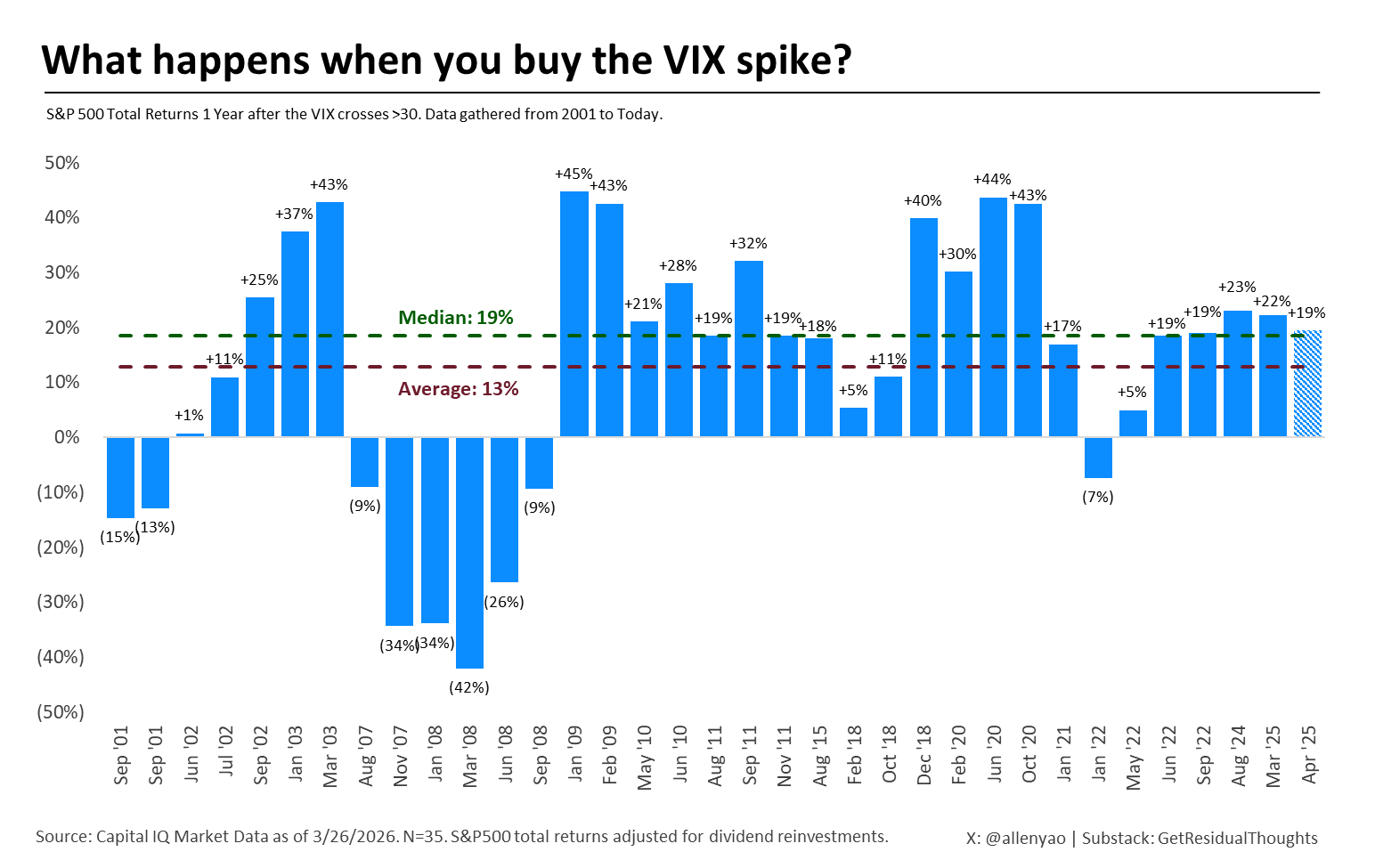
This chart was made a few days back when the VIX crossed 30. It’s since come back down to 26 as of today (3/31/26). Looking at every instance since 2001 where the VIX crossed 30, the S&P 500's median 1-year forward return is 19%, with an average of 13% even after including the ugly episodes. But zoom out and the base rate is hard to argue with. Out of 35 instances, the overwhelming majority printed positive returns in the year following the spike.
IV. For software, growth no longer matters.
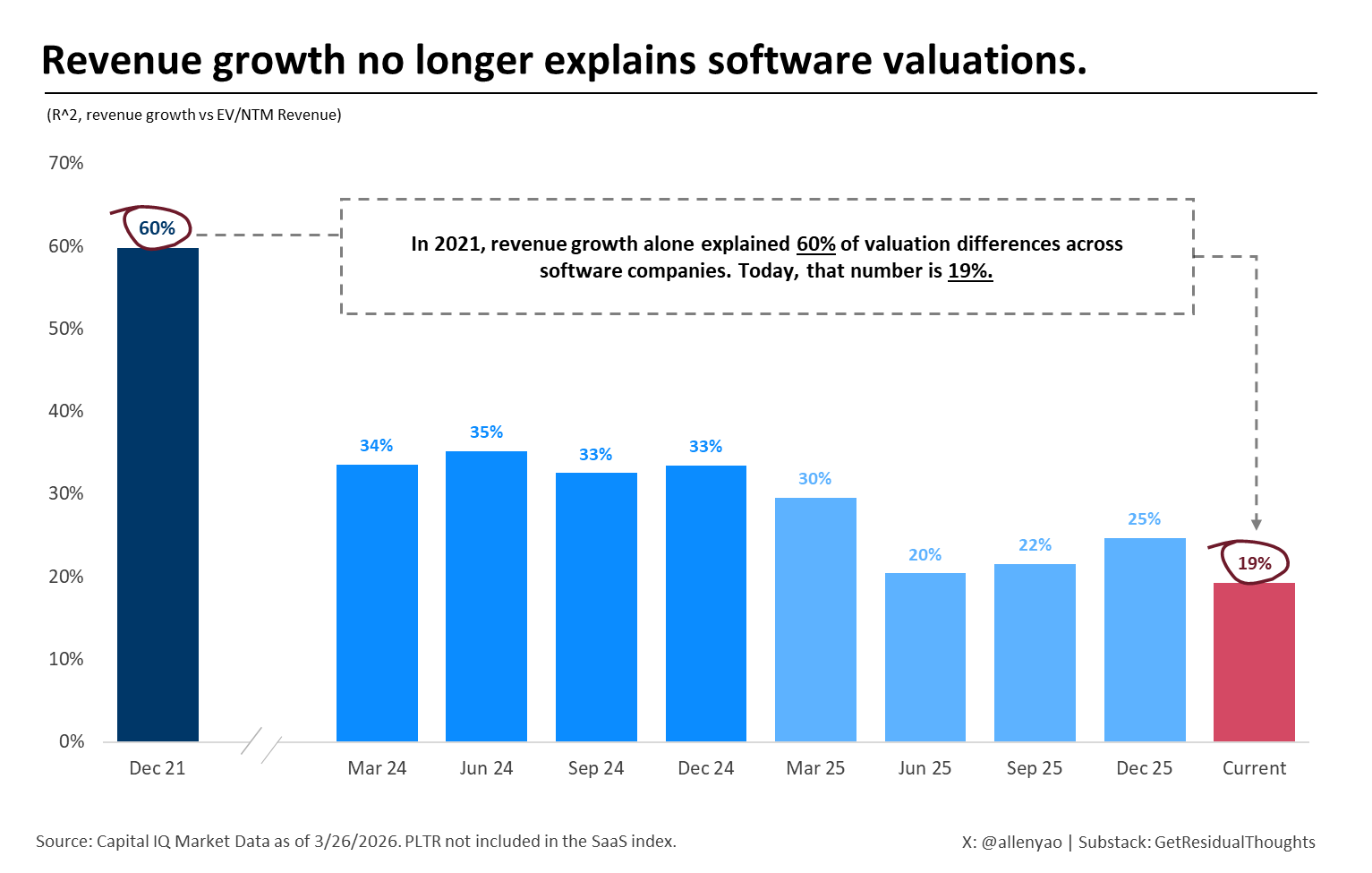
Companies keep growing, but valuations keep tanking. This is what happens when AI risk reprices the terminal value of legacy software businesses. The R^2 on revenue growth and valuation has come down from 60% highs to 19% lows. But what's the broader implication? Most valuation models for software are broken. Analysts built regression frameworks when growth was the signal. At a 19% R^2, revenue growth is now more noise than anything! If growth no longer explains valuations, what does -- and are analysts even measuring it?
V. Citrini’s basket keeps going up and down.
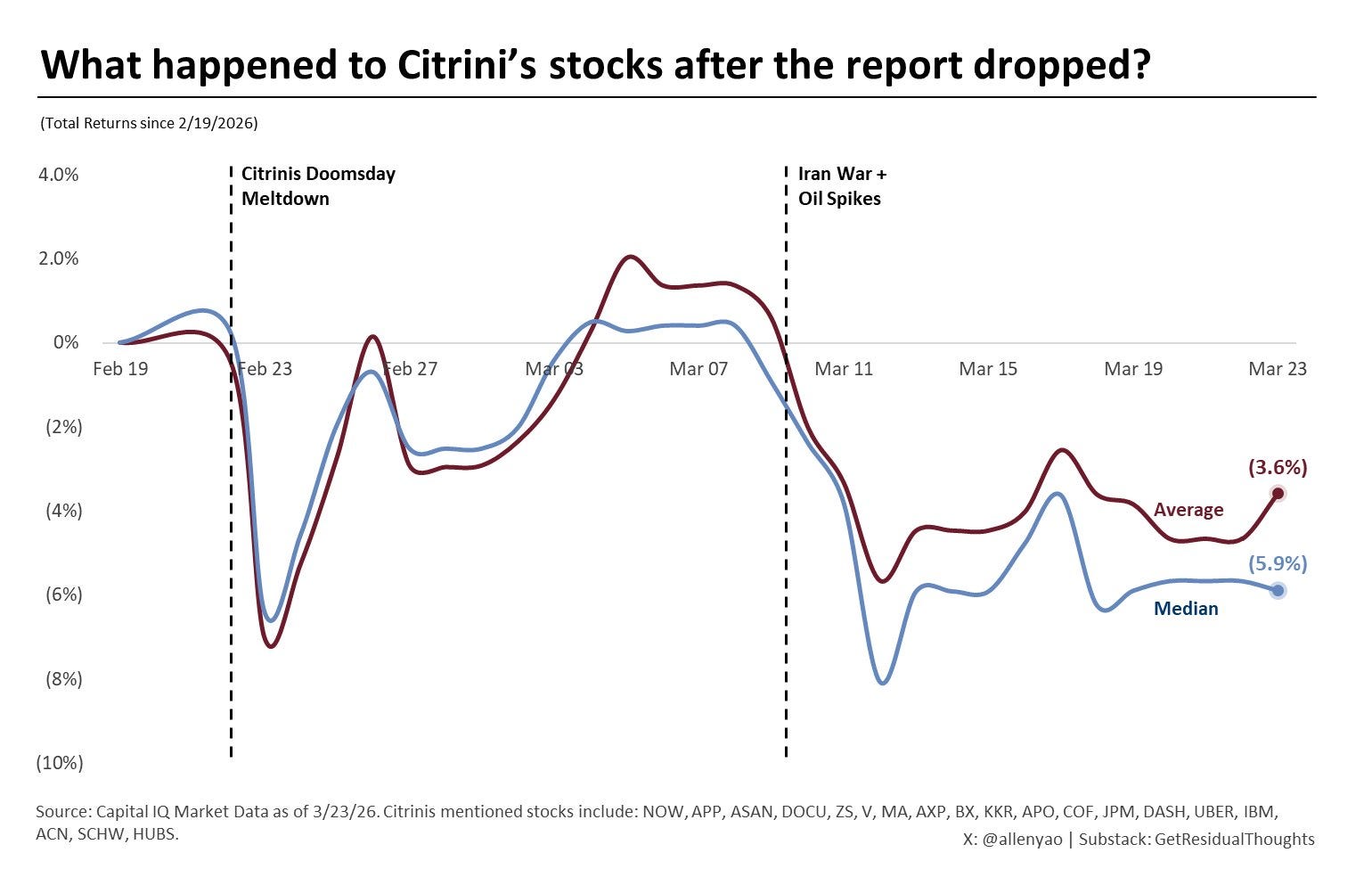
When Citrini’s “Doomsday Meltdown” report dropped on Feb 23, the basket of stocks he flagged sold off hard. But the recovery that followed was just as sharp, with the average clawing back to nearly flat by early March. That bounce looked like a textbook overreaction unwind: the report created forced selling, the dust settled, and buyers stepped back in. For a brief moment, it seemed like the bears had cried wolf.
Then the Iran War and oil spike headlines hit, and the thesis got a second wind it didn’t ask for. The median stock in the basket is now down 5.9% since Feb 19, with the average at -3.6%. This data is as of 3/23/2026. The basket of stocks may have recovered more, given that the Iranian conflict might be resolving soon.
VI. Prediction markets fueled by sports betting.
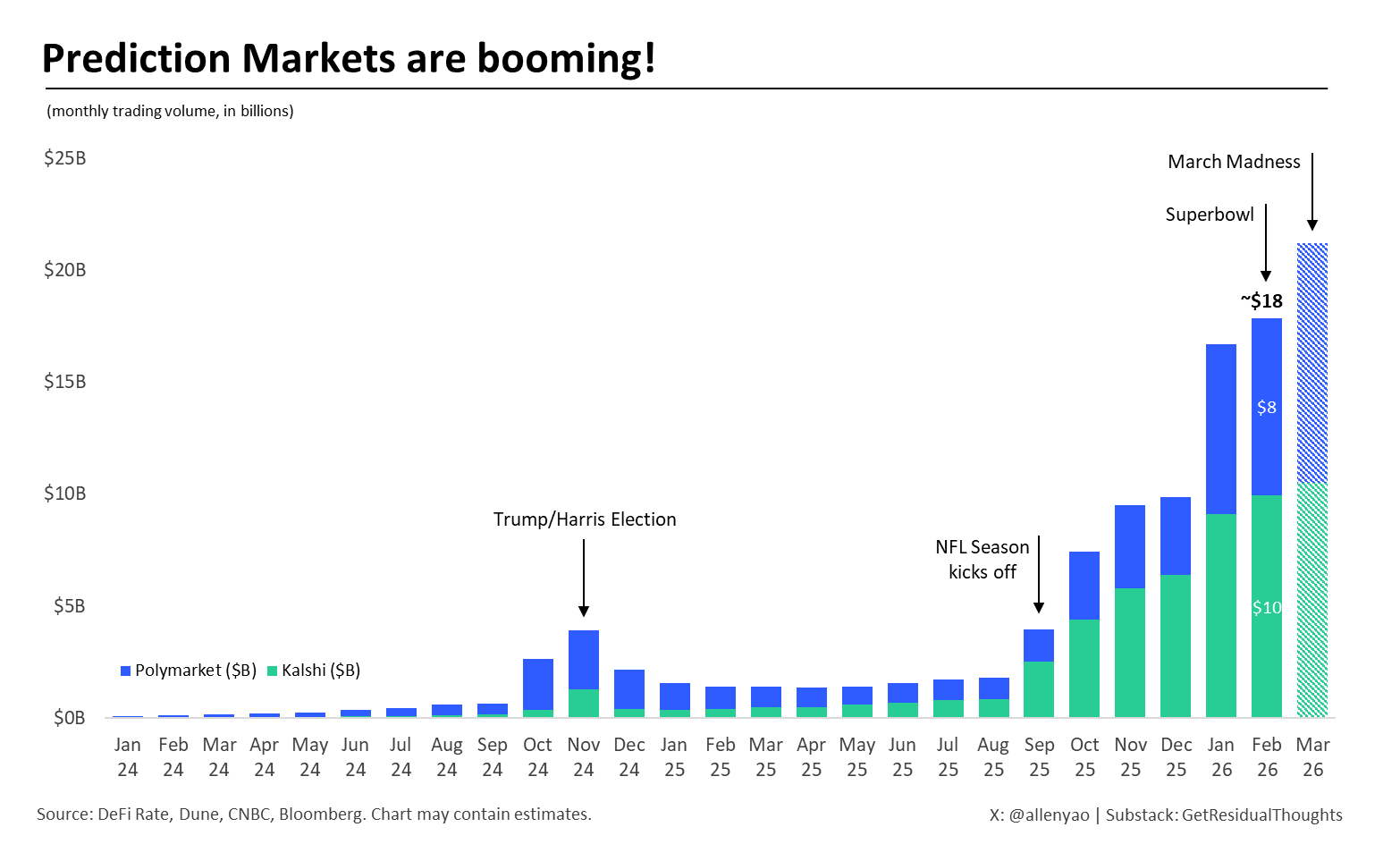
Prediction markets are on fire, and this feels like a new “culture” of our generation. Kalshi and Polymarket are reportedly raising at $20bn+; the charts above show public enthusiasm for prediction markets. However, regulation stands as the key question regarding the sustainability of these platforms.
The trajectory here isn't just "people like betting." It's that prediction markets are becoming an information layer: a place where price signals reveal what crowds actually believe, not just what they say. As of today, most of the trading volume comes from sports betting.
Can they move beyond elections and sports? The long-term bull case is prediction markets on earnings, Fed decisions, and geopolitical events.
VII. Open Source models are catching up!
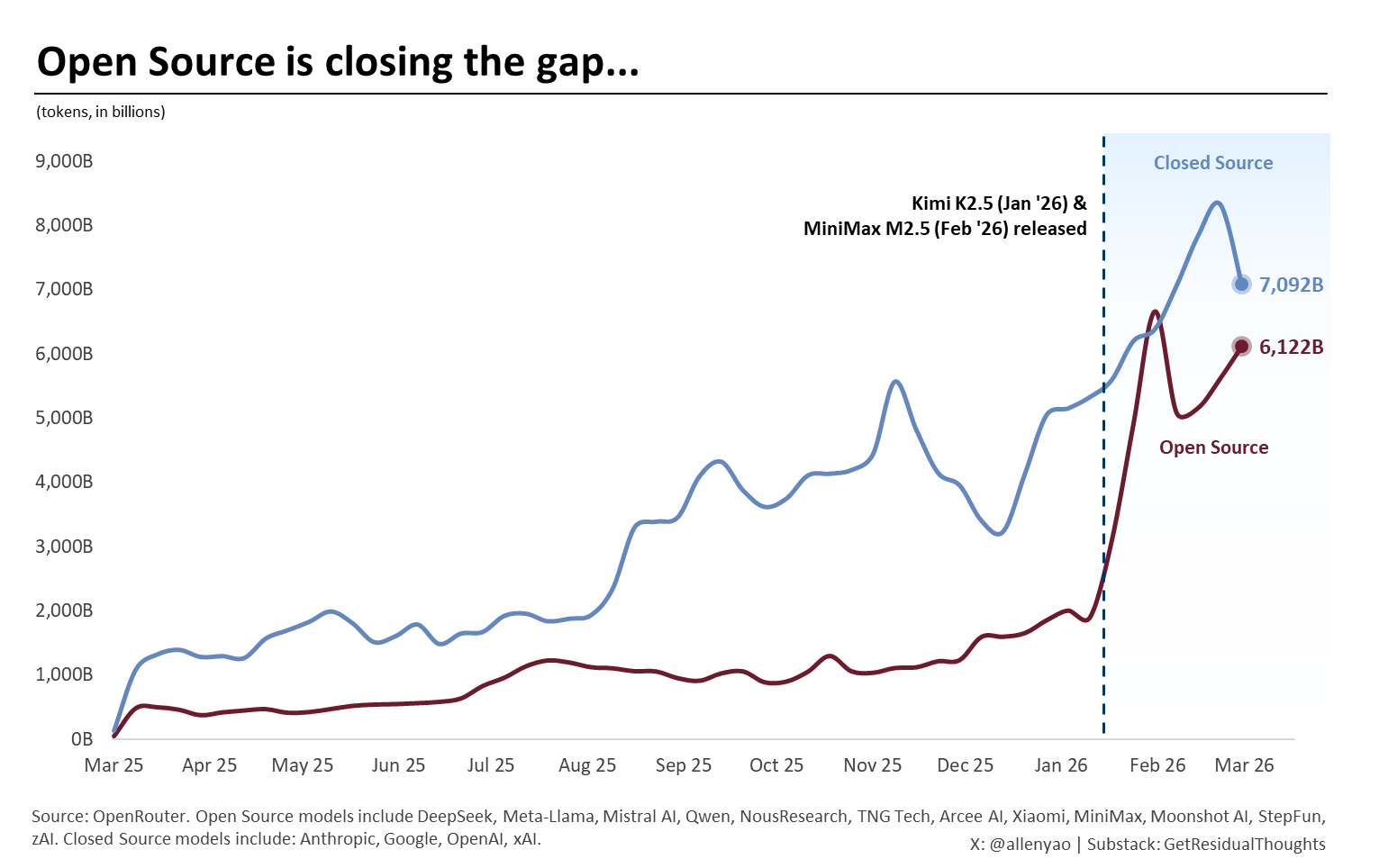
For most of 2025, open source trailed closed source by a comfortable margin. Then January and February 2026 happened where Kimi K2.5 and MiniMax M2.5 dropped in rapid succession, and open source token usage exploded.
The uncomfortable truth is that Chinese labs are winning the open source war, and Western labs have largely ceded the ground. Meta’s Llama lost momentum, and Reflection AI is the most credible Western attempt to fill that vacuum. The company is reportedly raising at $25bn valuation, per a WSJ report.
The need-to-believe for any open source lab is simple: ship SOTA fast, get developers on it before the closed labs iterate again, and hope the community compounds from there. If Chinese labs dominate this layer while Western labs stay closed, the default foundation of global AI development shifts.
Extremely insightful, data is far easier to absorb than text-based analysis